

Understanding the 2026 EP 2.2.44 Revision: Method B
Understanding the 2026 EP 2.2.44 Revision: Method B
The European Pharmacopoeia (EP) has introduced important updates to General Chapter 2.2.44, Total Organic Carbon in Water for Pharmaceutical Use. Effective from 1 July 2026, these revisions affect the reference materials used for Total Organic Carbon (TOC) System Suitability Testing (SST) and introduce a new testing approach for Sterilised Water for Injection (SWFI).
Method B applies specifically to Sterilised Water for Injection packaged in its final container.
The latest revision to EP General Chapter 2.2.44 introduces two significant changes. First, new Chemical Reference Substances (CRSs) have been introduced for System Suitability Testing (SST). Read more about this change here.
Second, a new Method B has been added for Sterilised Water for Injection (SWFI), replacing the historical Oxidisable Substances test with Total Organic Carbon (TOC) testing.
Method B also introduces container volume-dependent TOC acceptance limits. These changes bring the European Pharmacopoeia more closely into alignment with the approach introduced in USP <643> in 2021. In 2021, the United States Pharmacopeia (USP) revised chapter <643> on Total Organic Carbon (TOC) testing.
Their revision recognises that TOC results vary according to container size and therefore introduced container volume-dependent acceptance limits and a staged-testing procedure.
For pharmaceutical manufacturers, these changes make TOC analysis more representative of real-world conditions and packaging formats.
Method B – The removal of the oxidisable substances test
These changes to EP 2.2.44 remove the traditional oxidisable substances test for SWFI and replace it with the TOC test.
The oxidisable substances test was a visual, subjective, and colorimetric wet-chemistry method that relied on potassium permanganate. In contrast, TOC testing is a state-of-the-art, non-selective, and highly sensitive instrumental method. It detects a much broader range of organic impurities while providing objective, quantitative measurements.
By adopting TOC as the universal standard for pharmaceutical water, Ph. Eur. aligns its testing requirements with other major global health standards, particularly the United States Pharmacopeia (USP). This helps global pharmaceutical manufacturers simplify their testing protocols and maintain compliance across different regions.
The TOC test can be performed using modern instruments, which provide verifiable digital records and integrate directly with laboratory software. This shift strongly supports data integrity requirements (such as ALCOA+ principles) and EU GMP Annex 11 compliance, reducing the risk of human error associated with manual wet chemistry.
Method B – The introduction of container size dependent TOC limits
In line with USP, the new EP changes recognise that container size and packaging material can directly influence TOC results. There is an introduction of container volume-dependent TOC limits and a staged testing procedure.
The previous, universal approach, didn’t account for the way packaging interacts with the water it contains.
Smaller containers: higher risk of organic leaching
Small ampoules and vials have a higher surface area-to-volume ratio, meaning there is more container surface in contact with each millilitre of water. This increases the potential for organic compounds to leach from the packaging material, especially in polymer-based containers such as polyethylene (PE) or polypropylene (PP). As a result, TOC levels can appear artificially high.
Larger containers: lower TOC impact
In contrast, large bottles (500 mL to 1 L) have a lower surface area-to-volume ratio, so there’s less contact area per unit of water. Organic leaching is therefore reduced, leading to lower measured TOC values.
The 2021 USP revision and 2026 EP changes address this discrepancy by setting container-specific TOC limits, ensuring test results reflect genuine water quality rather than packaging influence.
1. Container-specific TOC limits
TOC limits are now determined by nominal container volume, replacing the single 8.0 mg/L C limit with three distinct categories:
| Container Volume (mL) | Limit 1 (mg/L C) | Limit 2 (mg/L C) |
| ≤ 5 | 32.0 | 48.0 |
| > 5 and ≤ 100 | 24.0 | 36.0 |
| > 100 | 8.0 | 12.0 |
This ensures smaller containers, which naturally have higher TOC potential, are assessed with realistic expectations.
2. Staged testing procedure
Initial assessment: If the measured TOC is at or below Limit 1 (L1), the sample complies.
Further investigation: If the measured TOC exceeds Limit 1 (L1), suitable analytical procedures must be used to identify and quantify any organic impurities present at concentrations greater than 0.20 mg/L of carbon.
Risk assessment: If any identified impurity exceeds 0.20 mg/L of carbon, compliance is determined using a risk assessment that evaluates the safety of those impurities at the measured concentrations.
3. Revised System Suitability Testing (SST)
System suitability concentrations (SSCs) must now reflect the TOC limits relevant to the container size. This ensures instrument validation is matched to the expected carbon range.
TOC analysers must meet the following criteria:
- Limit of Detection (LOD): ≤ 0.10 mg/L C
- System Suitability Solution: Prepared using 1,4-Benzoquinone R for USP or 1,4-Benzoquinone CRS for EP at concentrations aligned to container-specific limits.
- Standard Solution: Prepared using Sucrose R for USP or Sucrose for TOC Test CRS for EP at concentrations aligned to container-specific limits
These updates guarantee instrument sensitivity is appropriate for the new test requirements.
Why container size matters: the science behind TOC variation
Surface area-to-volume ratio
This is the dominant factor. Smaller containers expose more surface per unit of water, increasing the potential for organic leachables, particularly from plastics.
Headspace and oxygen exposure
Headspace allows limited oxygen diffusion or CO₂ ingress, which can slightly alter TOC values. However, in sealed sterile packaging, this effect is minor compared to surface area impact.
Storage duration and conditions
Longer storage times and elevated temperatures (e.g., sterilisation or shipping) can accelerate organic migration from packaging materials, particularly plastics.
Packaging material composition
Glass containers exhibit minimal organic leaching but can release trace inorganic ions (e.g., Si, Na). Plastic containers (PE, PP) are more susceptible to organic extractables and leachables, especially at smaller volumes.
Manufacturing and sterilisation residues
Residual cleaning agents or sterilants (such as ethylene oxide) can temporarily elevate TOC. Smaller containers are more affected due to their higher surface area and lower rinsing efficiency.
Collectively, these factors explain why pharmacopoeias now scale TOC limits according to container size – ensuring that TOC testing reflects real packaging behaviour rather than a single, arbitrary threshold.
What this means for pharmaceutical manufacturers
For laboratories performing TOC testing on Water for Injection (WFI), Purified Water, or Sterile Water for Irrigation, the revisions mean:
More accurate, representative TOC results
TOC limits now account for natural variability linked to container volume and material.
Better alignment between method and packaging
The testing reflects how the product is actually stored and used.
Enhanced system suitability validation
Instruments are now calibrated to realistic TOC levels for each packaging type.
Improved compliance confidence
The staged approach reduces the risk of unnecessary out-of-specification results caused by container artefacts.
Practical guidance for laboratories
Review internal TOC testing protocols
Ensure TOC limits, SST concentrations, and pass/fail criteria match the current container-specific requirements.
Verify analyser performance
Confirm the analyser’s limit of detection and overall performance meet the requirements of pharmacopoeia and the manufacturer’s recommendations
Use certified TOC standards
Use reference materials that align with USP <643> and/or EP 2.2.44 concentration ranges for each container size to maintain consistency and compliance.
Monitor long-term TOC trends
Track results by container type and batch to identify any packaging-related trends early.
An example
Let’s say you’re testing a 10 mL SWFI vial.
You would require:
- Reagent water
- 24 ppm sucrose (L1)
- 36 ppm sucrose (L2)
- 36 ppm benzoquinone
You would then:
- Run the Reagent Water.
- Run the 36 ppm sucrose and 36 ppm benzoquinone to confirm 85–115% Response Efficiency.
- Run the 24 ppm and 36 ppm sucrose standards to establish the L1 and L2 responses.
- Analyse your SWFI sample.
- Compare the sample response against L1 (and L2 if necessary).
EP 2.2.44 requires the analyser’s system suitability to be verified at suitable intervals, as with Method A. The frequency at which these standards are analysed should be defined and justified within the laboratory’s quality system, considering instrument stability, historical performance, batch testing frequency and overall risk.
The takeaway
The revisions mark a significant step forward in pharmaceutical water testing. By accounting for container size, it provides a fairer, more realistic measure of water purity.
For laboratories, this means fewer false failures, more meaningful TOC data, and improved regulatory alignment.
Supporting compliance with Altus Science
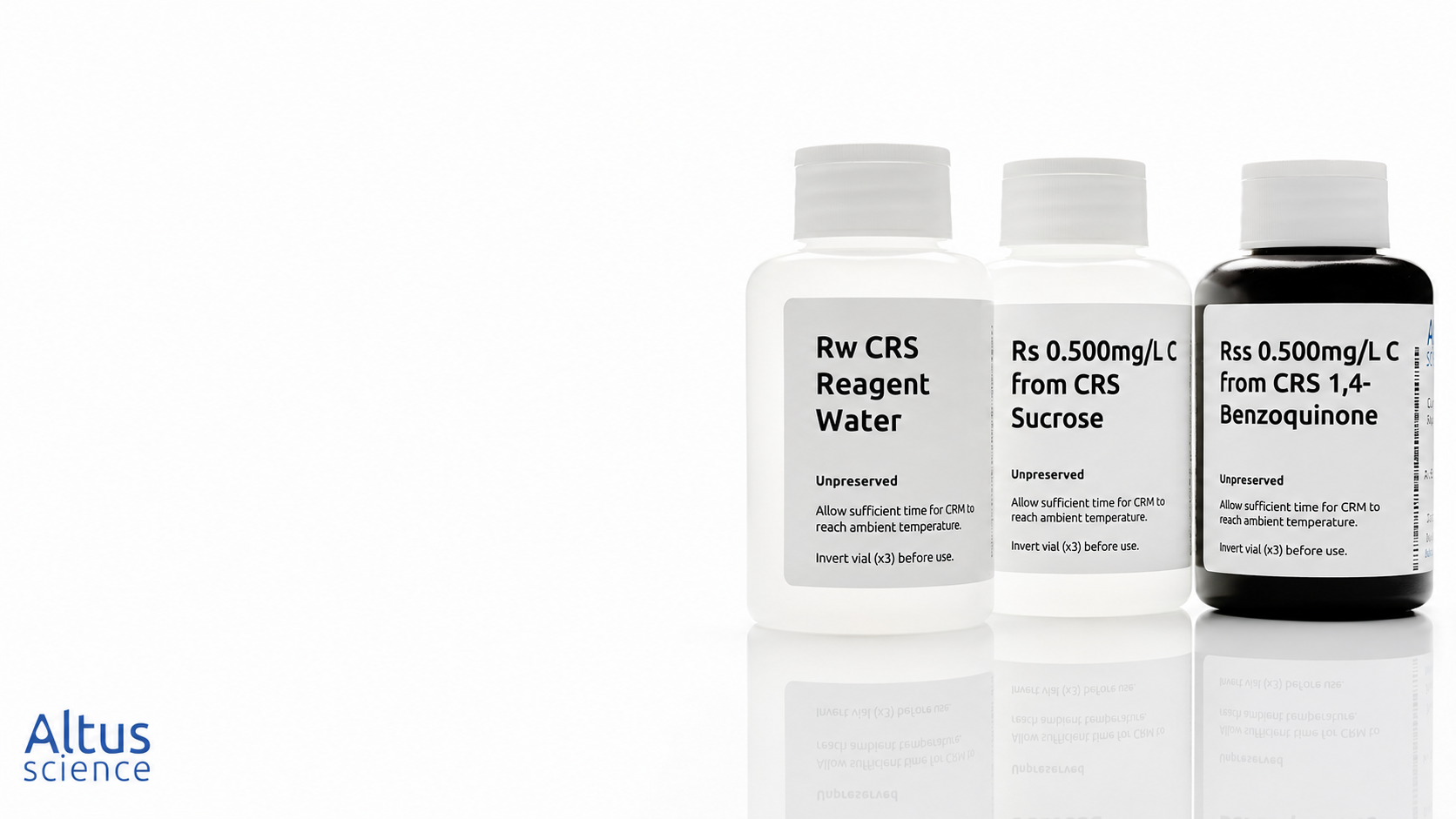
Altus Science now supplies separate USP and EP CRS System Suitability Kits, allowing customers to implement whichever testing strategy best aligns with their quality system.
Our EP System Suitability Kits are manufactured from official EP Chemical Reference Substances and are produced under our ISO/IEC 17025 and ISO/IEC 17034 accredited quality systems.
Altus Science also provides conductivity standards, TOC consumables, and vials designed for consistent, traceable results across all major analyser brands.
Need help selecting the right TOC standards for your container size or analyser?
Contact the Altus Science technical team today for expert guidance.